Broward Online Bail Bonds: Your Complete Guide
Learn how Broward online bail bonds work, from checking inmate status to securing release. A licensed South Florida agency walks you through every step.
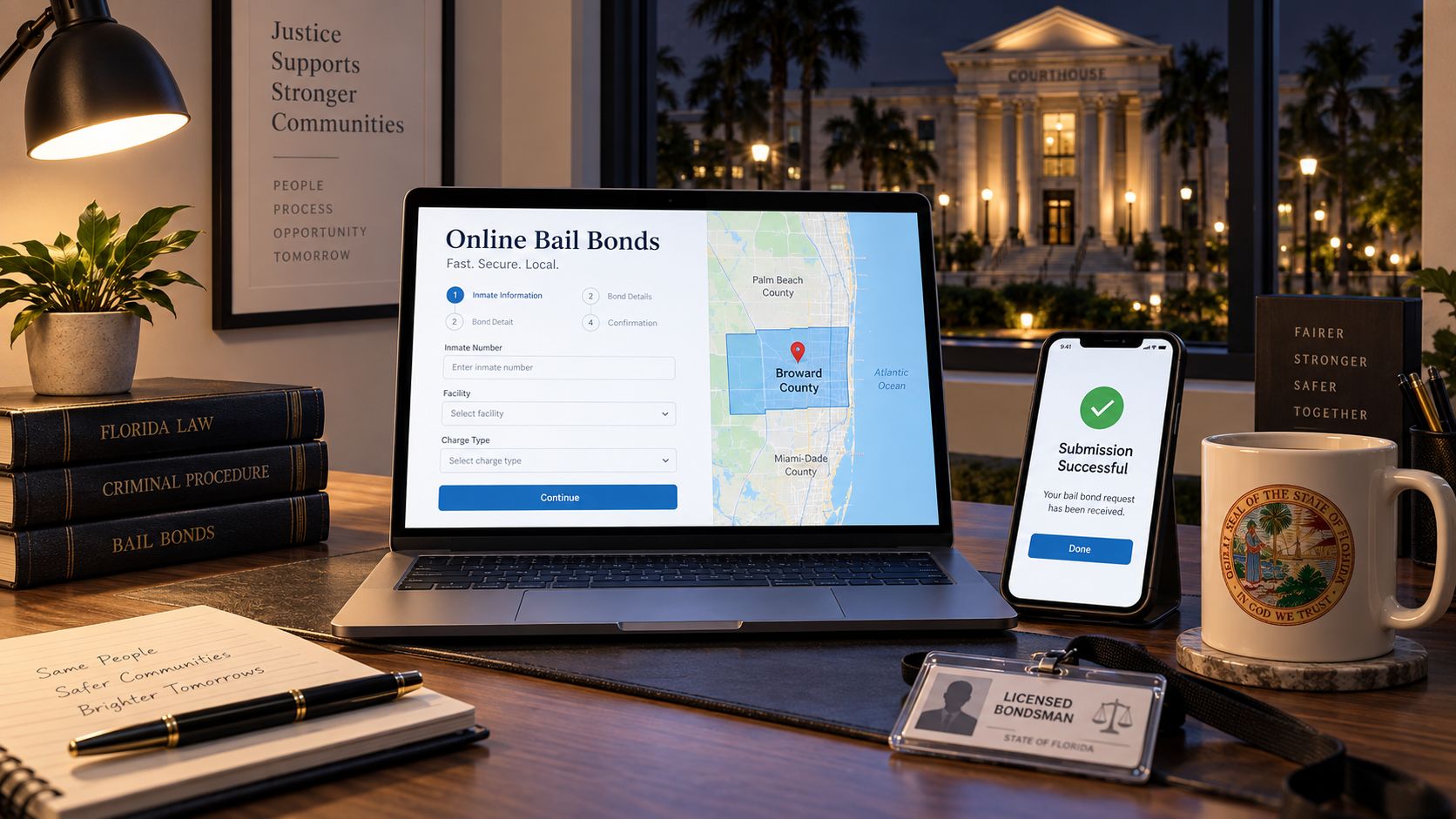
At 2 a.m., a family usually doesn't need a lecture about the criminal justice system. They need to know whether their loved one is booked into Broward custody, what bond has been set, who can sign, how payment works, and whether an online request can move the release forward before morning.
Broward online bail bonds can make the intake and paperwork much easier, especially when the indemnitor lives outside South Florida. But online service doesn't mean every step happens on a screen. In Broward County, custody verification, bond approval, jail processing, clerk procedures, court orders, and holds can still control the timeline.
This guide gives you the practical version. It separates what a licensed bondsman can handle remotely from what still requires a phone call, jail action, clerk involvement, or court approval.
When You Need Broward Online Bail Bonds at 2 a.m.
A sister in Atlanta gets the call after midnight. Her brother was stopped in Broward, the traffic stop escalated, and he has been booked into Broward County Main Jail. Her toddler is asleep beside her, her brother's employer expects him for a morning shift, and nobody in the family knows whether the arrest record is accurate or whether bond has even been set.
That family doesn't need to drive to Fort Lauderdale first. The useful work starts remotely. Someone must identify the correct defendant, confirm the facility, check the charges, determine whether a bond appears on the record, and identify the person who can legally act as indemnitor.
The first call should go to a licensed local bail agency, not to a random number found in a social media comment. A qualified agent can explain whether the information is sufficient to begin an application, what documents the signer needs, and whether a hold or court restriction prevents immediate posting. Families can also review practical guidance about bail agents available around the clock, but availability doesn't eliminate the need for verification.
What remote intake can accomplish
A genuine online workflow can usually help with:
- Information collection: The family submits the defendant's legal name, birth information, booking details, contact information, and charge information.
- Identity review: The indemnitor sends identification and confirms personal details by phone or secure electronic process.
- Agreement execution: Required bond documents may be reviewed and signed electronically when the agency's process permits it.
- Payment authorization: The agency can discuss an approved payment arrangement and collect authorized payment information.
- Bond preparation: The bondsman reviews the application and prepares documents for submission.
What it can't do is override a missing bond, an immigration detainer, a federal hold, a court order, or a jail's release protocol. An online form is an intake tool, not a private release order.
Broward's detention system has also operated near capacity. In March 2024, Broward County Jail/Main reported 957 inmates in 1,068 beds, or 93.8% capacity, while North Broward reported 639 inmates in 715 beds, or 93.6% capacity. April figures reported Main at 987 inmates in 1,106 beds, or 93.7% capacity, and North Broward at 679 inmates in 765 beds, or 92.4% capacity. These figures are documented in the Broward County jail population research summary, and they help explain why families should start coordination promptly.
By morning, a well-managed application should aim to establish four facts:
- The charges are confirmed.
- The bond amount and bond type are verified.
- The eligible indemnitor has completed the paperwork.
- The family has a realistic release window, not a promise that the jail can't guarantee.
Confirming Inmate Status and Bond Amount Remotely
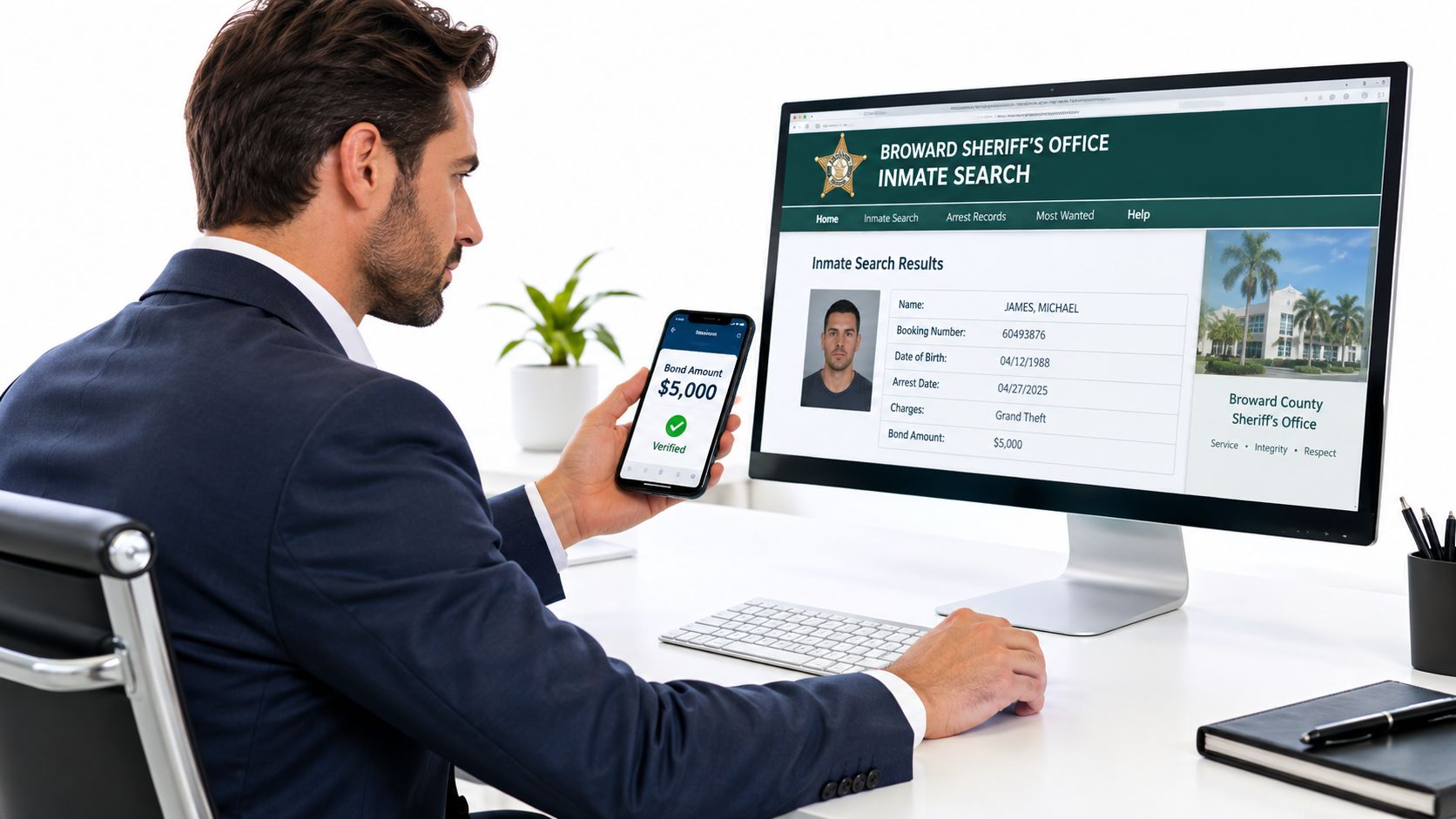
The most expensive mistake is paying before confirming that you're dealing with the right person and the right bond. Start with the official Broward Sheriff's Office inmate search, then have a licensed bondsman review the information before money changes hands.
Follow the record in order
Use the defendant's full legal name first. If the search allows a booking number, use that as the stronger identifier. Spelling differences can matter, especially with compound or Hispanic surnames, missing hyphens, alternate middle names, and reversed surname order. If the booking was recent, the public record may not yet show the complete charge or bond information, so an empty result doesn't prove that the person isn't in custody.
The official Broward Sheriff's Office arrest search guidance is useful for understanding what the public record can and can't confirm. Treat the search as a starting point, not as a substitute for direct verification.
Review the record carefully:
- Name and date of birth: Confirm that the identity matches the person your family knows.
- Booking number: Save it. It reduces confusion when multiple people have similar names.
- Charges: Read each listed charge rather than relying on a family member's description.
- Arresting agency: This can help explain whether another agency still has a role.
- Facility: Note whether the person is associated with Main Jail, North Broward, or another Broward location.
- Bond information: Confirm whether an amount and bond type are listed.
The bond amount is set through the legal process, not invented by the bondsman. A bondsman can explain how to satisfy it, but can't lower a court-controlled amount because a family asks.
Prepare the intake packet
Before contacting an agency, gather the defendant's full legal name, date of birth, booking number if available, listed charges, facility, and any paperwork provided by the jail or arresting agency. Each proposed indemnitor should have a government-issued identification document and accurate contact information.
The online form should identify the parties, explain the financial responsibility being accepted, disclose payment and collateral terms, and provide the documents required for execution. A real agent will still call to verify identity and intent. That call protects the family, the agency, and the integrity of the bond.
Payment Options and Bond Types Available in Broward
Families often focus on finding the lowest quote. In Florida, that can send you toward an illegal or unreliable offer. The better question is which lawful option fits the bond, the family's available funds, the indemnitor's qualifications, and the expected release process.
Florida's statutory framework says a bail bond agent's premium can't be higher or lower than the approved filed rate. Under the Florida statute governing bail bond agents, a below-rate advertisement isn't a harmless discount. It can be a compliance warning.
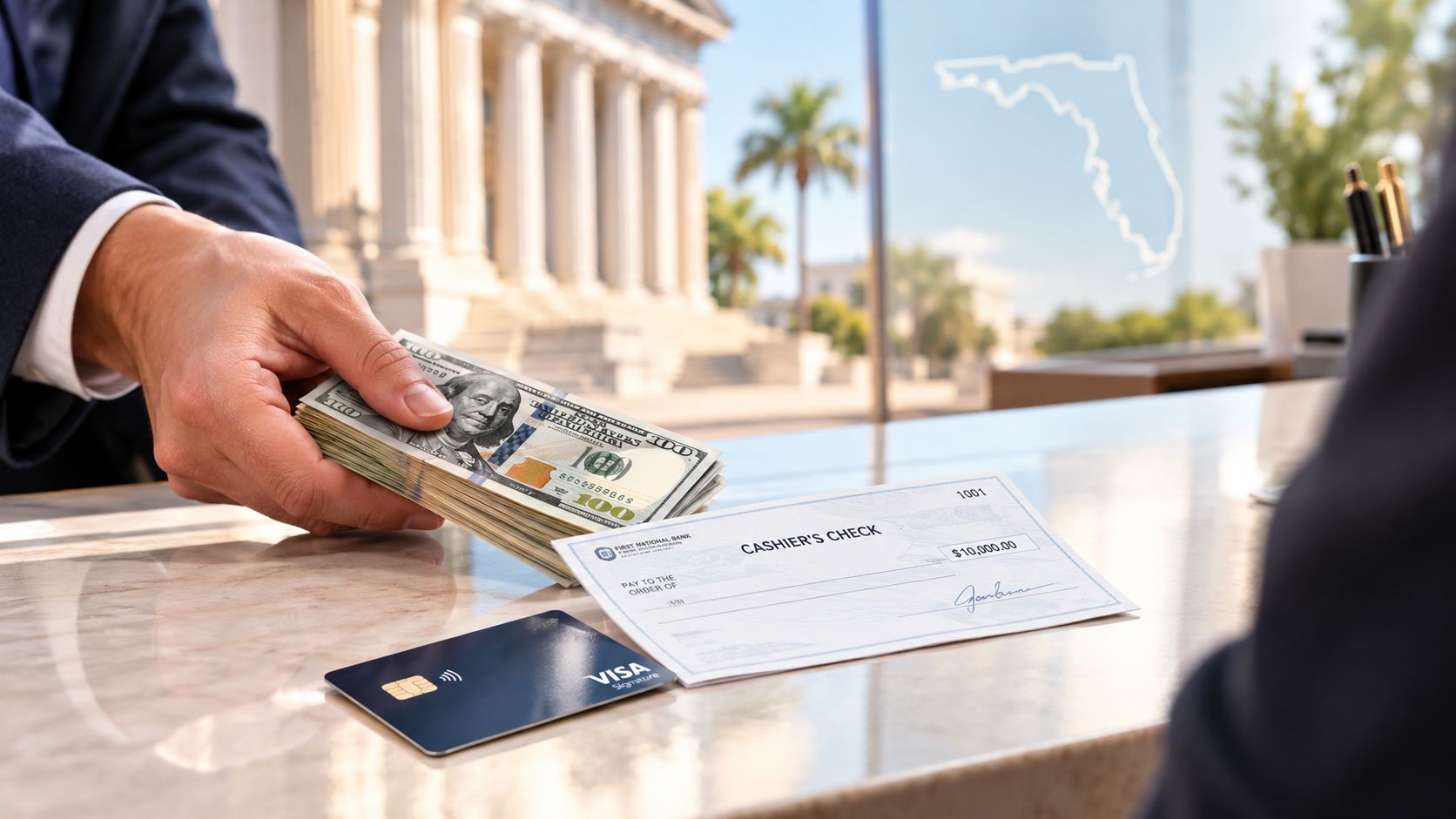
For a standard surety bond, families commonly discuss a 10% premium. On a $10,000 bond, that commonly means a $1,000 cash component. The premium is generally treated as the charge for issuing the bond, so families shouldn't assume it will be refunded because the criminal case later ends favorably.
Florida's 2026 statutory framework also addresses a 10% cash deposit. If conditions are satisfied and the defendant is discharged, the clerk returns 75% of that deposit and retains 25% as bail costs. On a $1,000 deposit connected to a $10,000 bond scenario, that means $750 returned and $250 retained, subject to the statutory conditions described in Florida Statutes Section 903.
Compare the practical choices
| Bond Type | Posted By | Typical Cost | Release Speed | Best For |
|---|---|---|---|---|
| Cash bond | Defendant or family through the authorized clerk or facility process | Full required deposit, with statutory treatment and applicable costs | Can be direct, but depends on accepted payment and processing | Families with sufficient liquid funds |
| Surety bond | Licensed Florida bail agent | Filed premium, commonly 10% for the standard scenario | Often practical when paperwork is complete | Families who need to preserve cash |
| Signature or PR release | Court-approved arrangement | May involve no bond premium | Depends on court approval and eligibility | Defendants approved for release without a traditional surety |
| Collateral-backed bond | Licensed bail agent with pledged security | Filed premium plus acceptable collateral terms | Depends on valuation, documents, and approval | Higher bonds or applications needing added security |
| Payment arrangement | Licensed bail agent and indemnitor | Approved premium schedule and any permitted terms | Can begin after authorization and verification | Families who can't pay the full premium at once |
Cash bonding doesn't mean the family bypasses the jail or clerk. The Broward Sheriff's Office explains that bond information, cash-bond processing, hours, and refund procedures can require direct confirmation through its official Broward bond information.
Collateral can include real property, vehicles with clear titles, or cash equivalents, but the agency must approve the security and document its terms. Payment plans may involve a down payment, scheduled installments, automatic withdrawals, and an assessment of the indemnitor's ability to perform. Ask for every term in writing before signing.
Timeline From Online Intake to Actual Release
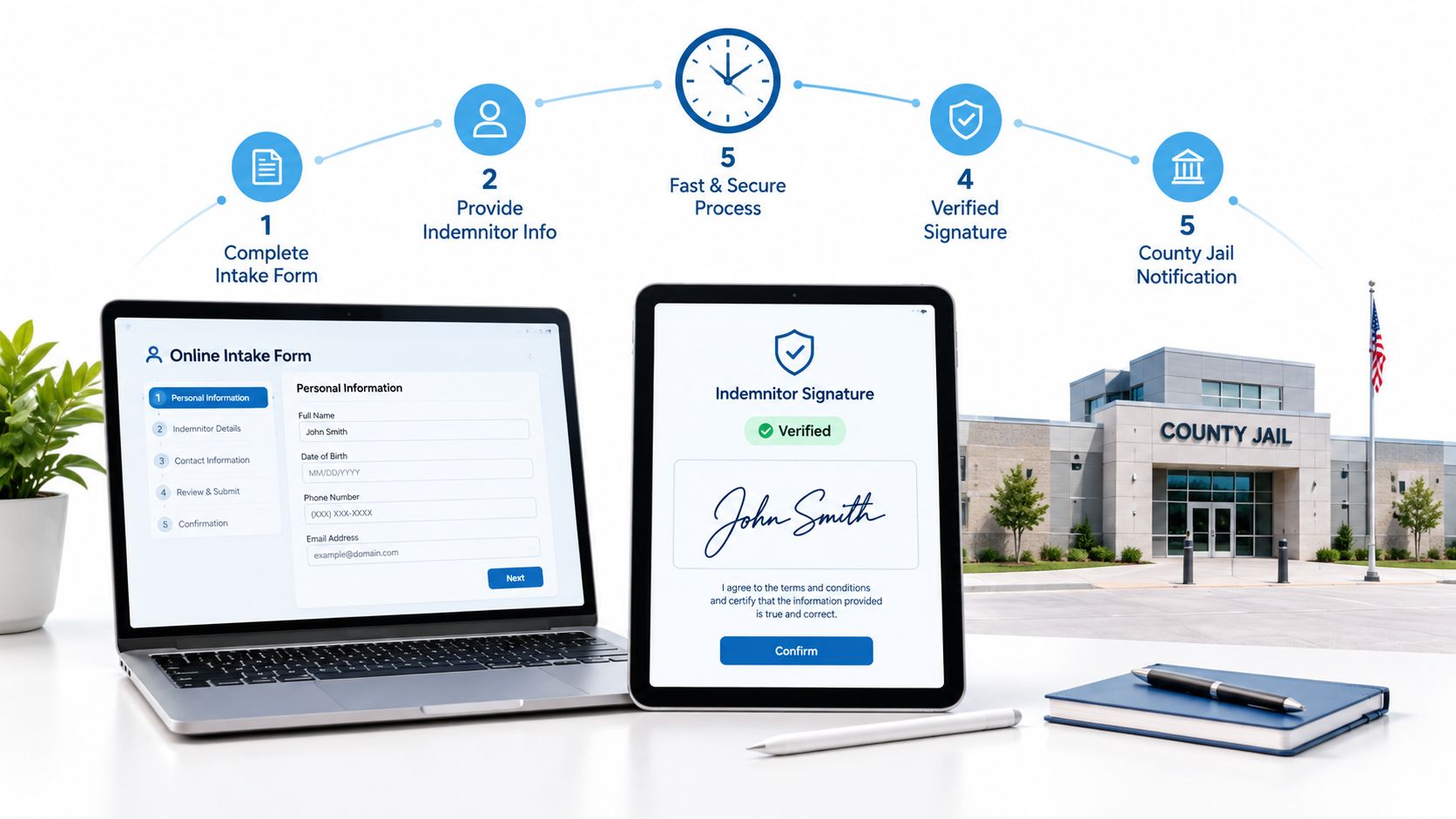
Online submission is the beginning of the release process, not the moment release occurs. The family should expect several separate handoffs, and each one can create a delay.
Research summarized by the Bureau of Justice Statistics found that about half of pretrial releases occur within one day of arrest, roughly three-fourths within one week, and more than 90% within one month. The same source reports that financial-release cases can take longer as bail amounts rise, with some lower-bail cases averaging 8 days. Another finding is especially important for online intake: 77% of defendants who eventually make bail do so during the first 48 hours after the bail hearing. These figures appear in the Bureau of Justice Statistics pretrial release report.
The five handoffs
First, intake and indemnitor verification. The family submits the information, sends identification, answers verification questions, and confirms who will sign. Stay reachable. A missed call or incomplete ID can stop the file immediately.
Second, bond review and preparation. The bondsman checks the charge, bond type, eligibility, payment authorization, and any collateral requirement. If the bond isn't available for posting, the agent should explain why instead of pretending the application is complete.
Third, submission to the appropriate facility. The agent transmits or delivers the bond documents through the accepted process. The indemnitor may need to e-sign an agreement, confirm a payment, or provide another document.
Fourth, jail processing and clearance. Jail staff review the filing, check for other holds, complete classification and release checks, and place the defendant into the facility's release queue. This is controlled by the jail, not the online agency.
Fifth, physical release. The defendant waits for property return, identity checks, instructions, and the facility's final release steps. A family member should arrange transportation and keep the phone available.
Same-day versus next-day expectations
During ordinary business activity, a complete filing may move toward release the same day. Overnight submissions, weekends, holidays, shift changes, incomplete records, and additional holds can push the process into the next operating period.
Normal delay includes waiting for jail review after the agent confirms submission. A stalled file is different. If nobody can tell you whether the bond was accepted, whether a required document is missing, or whether another hold exists, ask for a specific status and the next action.
Practical rule: Don't judge progress by the time the online form was submitted. Judge it by whether the agent can confirm verification, document execution, submission, and jail acceptance.
Special Cases That Change the Online Workflow
A routine state surety bond is only one version of a Broward release. The online intake may still begin the same way, but a hold or jurisdictional issue can change who must approve release and which documents matter.
An immigration detainer can prevent a state bond from producing release. A federal matter can move the case outside the ordinary Broward County jail workflow. An out-of-county transfer can require coordination with the facility that controls custody rather than the facility shown in an initial search.
Florida's current statutory framework considers factors such as offense severity, flight risk, community ties, immigration status, and financial resources when bail and pretrial release are evaluated. The 2025 Florida statute on pretrial release factors also reflects why an upload form can't decide every case. HB 323, effective July 1, 2025, further modernized bail-bond and forfeiture procedures, so old online advice may not match the current process.
Where the ordinary workflow breaks
| Scenario | Online Steps That Still Apply | Steps That Must Move Off-Line | Impact on Release Time |
|---|---|---|---|
| Immigration detainer | Collect identity, custody information, sponsor details, and available case documents | Confirm the detainer and coordinate with the responsible immigration authority or counsel | A state bond may not produce release until the immigration matter is addressed |
| Federal hold or federal case | Gather defendant and sponsor information and begin document review | Coordinate with the federal court, U.S. Marshals process, or counsel handling the federal matter | State jail procedures may not control the release |
| Transfer from Miami-Dade, Palm Beach, or another county | Submit preliminary information and verify the defendant's location | Confirm which facility has custody and which agency can accept the bond | The first facility may not be the posting location |
| Weekend or holiday booking | Complete intake, identification, and payment authorization remotely | Confirm clerk, court, and jail operating procedures by phone | Court-controlled actions may wait for the next available operating period |
A family should ask one direct question early: Is there any hold that prevents a standard Broward surety bond from producing release? If the answer isn't clear, don't treat the application as routine.
Spotting Scams and Verifying a Licensed Broward Bondsman
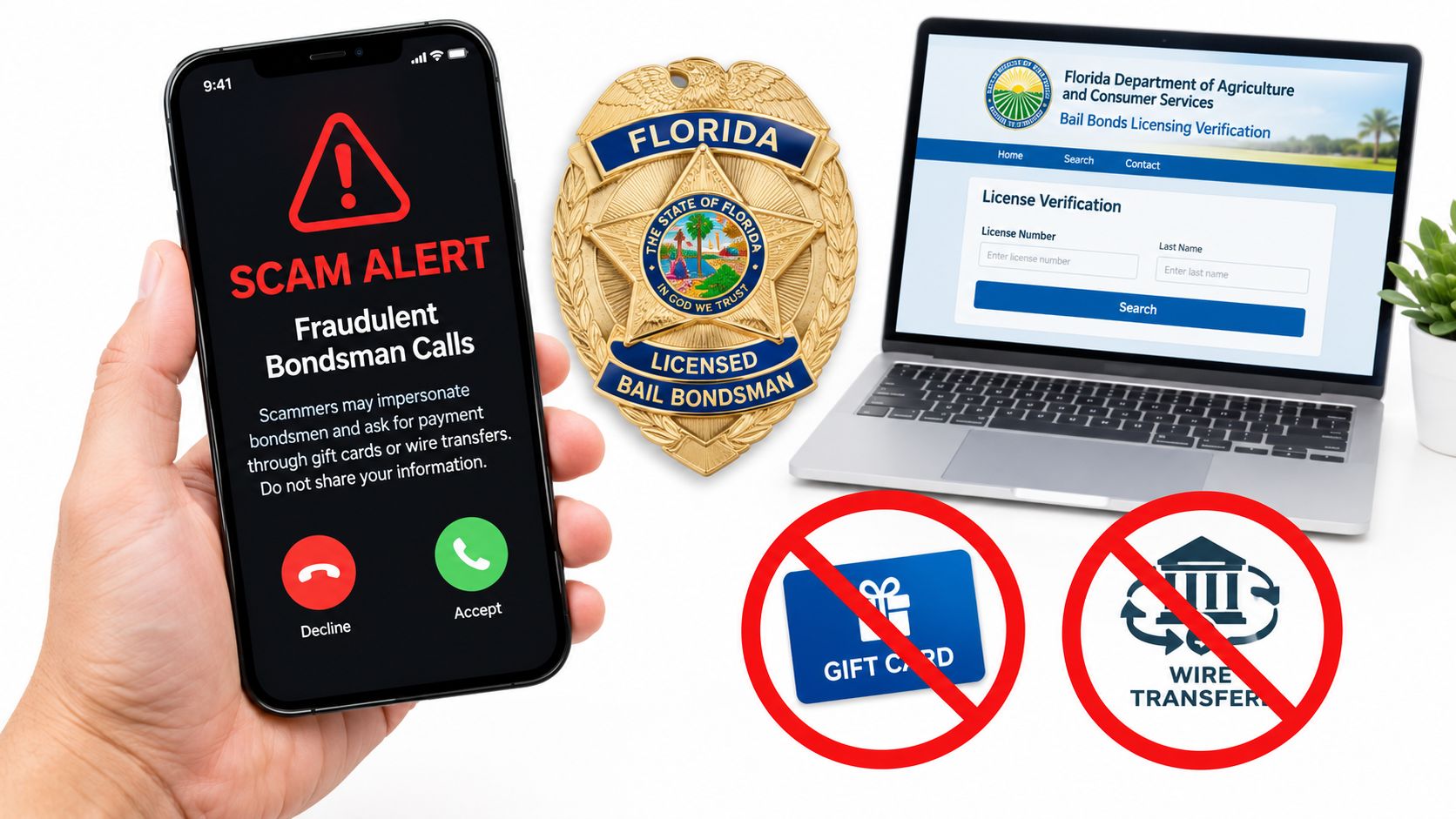
Panic creates a perfect opening for fraud. A caller may claim to be connected to the Broward Sheriff's Office, use a spoofed local number, demand a gift card, or insist that a wire transfer must happen immediately to prevent the defendant from being moved. Those are not normal reasons to skip verification.
Another warning sign is a quote below Florida's filed premium. Florida law prohibits a bail bond agent from charging above or below the approved filed rate. A cheap quote isn't automatically a bargain. It may signal an unlicensed person, an incomplete quote, or an attempt to collect money without issuing a valid bond.
Use a verification checklist
- Confirm the license: Search the agency or agent through the Florida Department of Financial Services licensing resources.
- Check the location: Verify a real Broward or South Florida business address rather than relying only on a website contact form.
- Call a local number: Ask whether the person answering can explain the defendant's facility, bond type, and next document.
- Request the agreement: Review the premium, payment schedule, collateral terms, indemnitor duties, and surrender provisions before authorizing payment.
- Reject pressure tactics: Gift cards, cryptocurrency demands, unexplained wire instructions, and threats that you must pay within minutes are serious red flags.
- Compare the name: Make sure the name on the agreement, license information, payment recipient, and agency contact details match.
A compliant quote should identify the bond amount, the lawful premium, the documents required, and any separate collateral or payment terms. A scam pitch usually avoids written details and focuses on urgency.
Families can also review how to find the right licensed bondsman before sharing sensitive information. If a dispute arises, preserve receipts, messages, agreements, and call records, then contact the Florida Department of Financial Services Division of Consumer Services for the appropriate complaint path.
After Release Staying Compliant With Your Bond
The most relieved moment is when the defendant walks out of Broward custody. The bond obligation doesn't end there. The defendant's release depends on compliance, and the indemnitor remains responsible for the promises made in the bond agreement.
Start with the court calendar. The defendant must appear at every scheduled Broward court date, follow release conditions, obey no-contact orders, avoid new arrests, and keep the bondsman informed about address or telephone changes. A missed notice can become a serious problem, so the defendant and indemnitor should maintain their own calendar rather than relying on memory.
Payment plans require the same discipline. Record each due date, keep the authorized payment method current, and contact the agency before a payment fails. A missed installment can trigger contractual consequences, and the agreement may give the agent rights to seek surrender when the indemnitor or defendant breaches its terms.
Keep this checklist where everyone can see it
- Court dates: Confirm every hearing and arrive as directed.
- Release conditions: Read the order and follow restrictions exactly.
- No contact: Don't contact protected people when an order prohibits it.
- New charges: Avoid conduct that creates another arrest or violates release terms.
- Bondsman updates: Report changes in address, telephone number, employment, or travel plans.
- Payment schedule: Make each installment on time and save confirmation.
- Documents: Keep the bond agreement, court paperwork, receipts, and agency contact information together.
If a bond is forfeited, the legal and financial consequences can expand quickly. Florida's forfeiture framework includes a 75-day window to return the defendant or satisfy the judgment, and the indemnitor may face financial exposure under the agreement. The exact response depends on the facts, the bond documents, and the applicable procedure, so contact the bondsman and a defense attorney immediately rather than waiting for a notice to escalate.
A successful online bond is not a one-time purchase. It is a continuing agreement tied to court attendance, lawful conduct, accurate contact information, and payment performance.
Blandon Bail Bonds, Inc. provides remote intake, payment arrangements, and bail coordination for Broward and other South Florida cases, with support for state, federal, and immigration-related situations. If your family needs help separating the online steps from the jail or court steps, visit Blandon Bail Bonds, Inc. to begin a confidential application and get direct guidance on the documents and next action.