Federal Bail Bonds Explained from Cost to Release
Learn how federal bail bonds work, how they differ from state bail, what they cost, and how to post one — plus how Blandon Bail Bonds helps 24/7.

A late-night call can make a familiar legal system feel completely foreign. A family member says their loved one was arrested on a federal warrant, the facility can't provide a simple bail amount, and the questions start immediately: Can a bondsman help? Is there a federal bail schedule? What will release cost?
If you've handled a county arrest before, your instincts may point you in the wrong direction. Federal courts usually don't treat release like a standard price quote. The judge may approve personal recognizance, an unsecured bond, property, or an approved surety, with supervision conditions that matter as much as money. The first task is finding out which release path the court has authorized.
When a Federal Case Changes Everything About Bail
The family usually begins with one urgent request: “Tell me how much we need to pay.” In a federal case, that may not be the question the court is asking. The judge first considers whether the person can be released safely and reliably, then chooses conditions designed to address appearance and community safety.
That decision might involve a promise to appear, financial guarantees, travel limits, drug testing, electronic monitoring, or other supervision. A secured bond can be part of the order, but it isn't automatically the starting point. Federal court guidance explains that judges set release conditions based on factors including flight risk and community safety, and federal cases don't use a fixed schedule or limit for bond amounts according to the Eastern District of Missouri's pretrial services FAQ.
What the family needs to unlearn
State-court experience often creates three assumptions:
- A schedule determines the amount. Federal judges generally decide conditions case by case.
- A commercial bondsman can always post the bond. Many federal districts rarely use commercial bail bonds in practice.
- Payment completes the release. Detainers, documentation, court approval, and supervision arrangements can still affect the timeline.
Federal law permits several forms of release. The court may use recognizance, which is a defendant's personal promise to appear, or an unsecured appearance bond, which creates a financial obligation without requiring money or property at the outset. If those options don't reasonably assure appearance, the court may require a secured bond or a surety with adequate financial resources.
The first question isn't “How much is the fee?” It's “What kind of release did the judge authorize?”
That change in perspective gives a frightened family a workable path. Get the case number, identify the district and facility, speak with defense counsel, and obtain the written release order. Only then can anyone evaluate whether a federal bail bond is available, what documentation is required, and whether a less restrictive release option may be faster and safer.
Understanding Federal Bail Bonds and Their Legal Roots
A family arrives at a federal courthouse expecting a familiar question: how much money will secure release? The judge may be focused first on supervision, appearance, and community safety. Federal release is adapted to the case, so the written order matters more than a preset price.
A federal bail bond is a financial guarantee tied to that order. A surety, such as a qualified individual or an approved professional arrangement, promises that the financial obligation will be honored if the defendant fails to comply. Under the federal Bail Reform Act, a judge may require a bond with solvent sureties only when release on recognizance or an unsecured bond is not adequate. The surety must disclose assets, liabilities, and encumbrances, with enough unencumbered net worth to cover the bond amount under the federal statute governing release.
The structure reflects a major shift in federal policy. The Bail Reform Act of 1966 was the first major federal bail reform since the Judiciary Act of 1789. It created a presumption that non-capital defendants should be released on personal recognizance or an unsecured personal bond unless a less restrictive condition would not reasonably assure appearance. It also authorized conditions such as travel limits, an appearance bond, and a bail bond backed by solvent sureties, as described in a historical federal review by the Government Accountability Office.
Why non-financial release comes first
The 1966 framework also became associated with the 10% deposit bond option, allowing a defendant to deposit 10% of the full money-bail amount with the court instead of using a full surety bond. Historical reviews of the reform note that the Manhattan Bail Project reported a failure-to-appear rate of less than 0.7% in the GAO review. That result influenced later debates about whether money was necessary in every case.
The practical lesson is straightforward. A federal judge may view a reliable address, responsible supervision, employment, family support, and compliance with testing or travel rules as more useful than a large payment. A financial bond becomes relevant only when those protections do not reasonably assure appearance.
Families can review Blandon's guide to federal bail bonds to organize questions. The release order and local court rules control the case, including whether recognizance, an unsecured bond, property, or an approved surety is available.
How Federal Bail Differs From State Bail
The biggest difference is customization. State courts often work with a bail schedule and routinely use commercial surety bonds. Federal judges evaluate the individual defendant, the allegations, the proposed supervision, the risk of flight, and community safety before choosing release conditions.
Federal law still permits financial forms such as cash bonds, property bonds, and bail bonds. In practice, most federal districts no longer rely on commercial bail bonds as a routine release method. A federal review reported that 72.7% of people accused of federal crimes and presented to a court were released under the federal pretrial system discussed in that report, illustrating the system's movement toward non-bond release mechanisms in the federal-courts overview available through the Office of Justice Programs.
State Bail vs Federal Bail at a Glance
| Factor | State Bail | Federal Bail |
|---|---|---|
| Who sets release | A state judge or a preset schedule may determine the initial amount | A federal judge sets conditions case by case |
| Main decision factors | Charge classification, schedule, criminal history, and local rules | Appearance risk, community safety, personal circumstances, and proposed conditions |
| Fee structure | Commercial surety is commonly available where state law permits it | No universal federal price. The court may approve non-financial release, cash, property, or an approved surety |
| Collateral | Often depends on the bond amount, agency rules, and state regulation | May be required when the court orders a secured bond and accepts the offered property |
| Release speed | Often follows a familiar county workflow after payment and processing | May depend on hearings, court approval, facility procedures, surety review, and holds |
| Typical conditions | Court dates, no-contact orders, and local restrictions | Travel limits, passport surrender, drug testing, monitoring, curfews, and other supervision |
The district-specific question
A family shouldn't assume that a Florida state bond process transfers directly to federal court. The district may require cash, property, or a surety approved under court rules, and a commercial agency may not be able to post the bond just because a federal order mentions “surety.”
Ask counsel or pretrial services for the exact release forms permitted in that district. Then ask whether the court requires Treasury approval or another qualification for the surety. That answer determines whether the family needs a bondsman, a property owner, a bankable co-signer, direct funds, or a supervision plan.
What Federal Bail Bonds Cost
A federal release order may involve no financial bond at all. The court can release someone on personal recognizance or an unsecured promise, or require property, cash, or an approved surety. The practical cost depends on the structure the district permits, the surety's review, the collateral offered, and the administrative work required.
A family may hear “appearance bond” and assume a signature is enough. An unsecured promise may fit the court's conditions, while a secured bond can require property or another form of acceptable security. The written order controls what the court will accept, and proposed collateral must reasonably support the defendant's appearance, as described under the Department of Justice's release guidance.
Why asset disclosure matters
Financial information helps the court assess whether a proposed surety and collateral are reliable. The surety may need to disclose:
- Assets: Property and accounts the person owns and can document.
- Liabilities: Loans, judgments, support obligations, and other debts.
- Encumbrances: Mortgages, liens, claims, or restrictions affecting property.
- Net worth: The unencumbered value available to support the bond.
Consider a relative who offers a home as collateral. Its market value may look substantial, yet a mortgage or other lien reduces the equity available to the court. The family would need documents showing ownership, current obligations, and usable value. A judge or clerk may request a title report, appraisal, or additional proof before approving the security.
The question is not whether the family owns property. The court must determine whether that property is documented, available, and dependable for the release order.
A property offer is not the same as approved collateral. The court must be satisfied with both value and reliability.
Collateral also carries an opportunity cost. Property committed to a secured bond may be unavailable for housing, business needs, legal expenses, or emergencies until the court releases the surety. For that reason, an unsecured or supervised release order may serve the family better than a larger secured arrangement, even when property is available.
For general background on bail-industry pricing, families can review Blandon's explanation of average bail bond costs. Federal cases still require a separate review because federal courts do not use one universal fee schedule for every release order.
Posting a Federal Bond Step by Step
A family may arrive at the federal facility ready to pay, only to learn that the release decision has not been made. The process starts with the court. At the initial appearance, a magistrate judge considers release or detention and enters an order listing the approved form of release and each condition.
The practical sequence
Confirm the hearing result. Get the written release order. It should show whether the defendant is released on recognizance, an unsecured bond, a secured bond backed by property, or an approved surety arrangement. That order is the family's roadmap.
Identify the district's procedure. Ask the clerk, pretrial services officer, defense attorney, or approved bond professional whether the district accepts the proposed form of surety. Federal courts do not automatically treat a commercial bondsman as an authorized option.
Prepare the financial file. The proposed surety should collect government identification, ownership records, account information, income records, mortgage statements, lien details, and documents showing other assets and obligations. The required paperwork depends on the district and the bond structure.
Submit the surety for review. The court may examine the surety's assets, debts, encumbrances, and relationship to the defendant. Missing records, conflicting information, or unclear ownership can slow approval.
Complete approved paperwork and posting. After the court accepts the surety and release conditions, the authorized party signs the bond and coordinates posting with the appropriate federal facility or clerk's office.
Coordinate facility release. Court approval does not always produce immediate release. The facility must receive and process the order, verify identity, complete its intake steps, and clear any separate hold.
Track compliance through exoneration. Under Rule 46, the surety is exonerated when the bond condition is satisfied, the defendant is timely surrendered, or forfeiture is set aside or remitted. Families can review the full text of Federal Rule of Criminal Procedure 46 for the governing language.
Documents to start gathering
Start with the case number, defendant's full legal name, date of birth, arrest location, facility, attorney's contact information, and district handling the case. Then identify anyone who may serve as a surety or offer property. Do not promise that a person or asset qualifies until the court reviews it.
Common delays include an unavailable written order, incomplete property records, undisclosed liens, an incorrect bond form, or an uncleared hold at the facility. Early collection will not guarantee release, but it gives counsel and the court a usable file instead of uncertain answers.
Special Holds and Conditions That Change the Timeline
A bond order alone rarely guarantees immediate release. Other holds, financial reviews, and facility procedures can keep a defendant detained after the court approves a release plan. The family needs to identify which step remains open before assuming that payment will solve the delay.
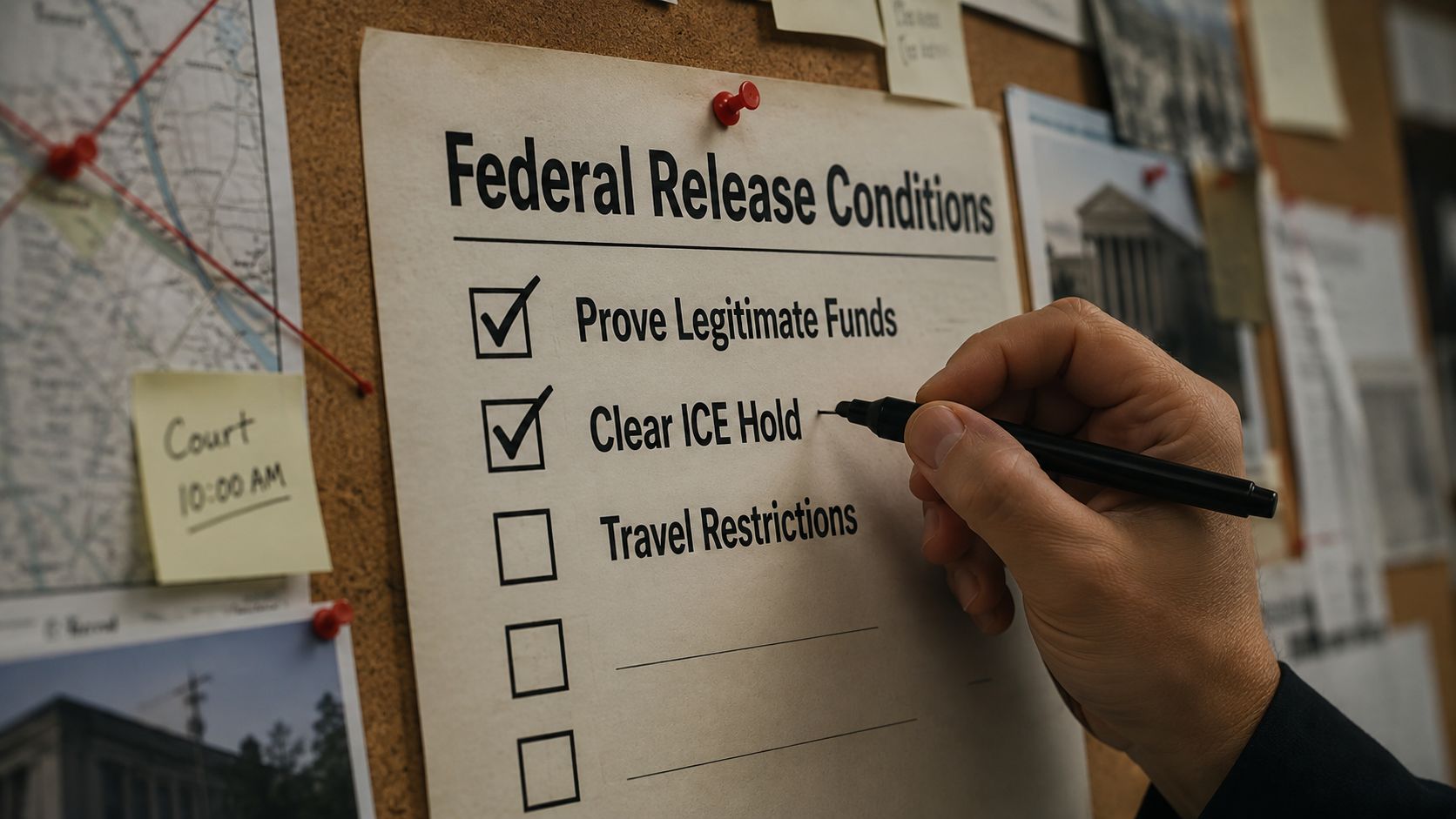
The court may require the defense to document the legitimate source of funds or property. This review is commonly associated with a Nebbia hearing. Counsel may need to show that the money or property supporting release comes from lawful, documented sources and is not connected to the alleged conduct.
Families can review Blandon's explanation of a Nebbia hearing. A bond may be financially available while approval remains pending because ownership records, liens, or the source of funds are unclear.
Conditions can be more important than the bond
Federal release usually depends on supervision conditions as much as on the form of financial security. Under 18 U.S.C. § 3142(c), an order may require the defendant to follow conditions such as:
- Travel limits: Leaving the approved area may require permission.
- Passport surrender: International travel documents may be held or restricted.
- Drug testing: Testing can continue throughout release.
- Electronic monitoring: The defendant may need equipment and an approved residence.
- Curfews: The order can restrict movement during specified periods.
- Pretrial reporting: The defendant may have to maintain regular contact with pretrial services.
These requirements help explain the available release choices. One defendant may receive an unsecured appearance bond, while another may need property collateral or remain detained until a concern is addressed. The judge is matching supervision and security to appearance and safety concerns, based on the individual case.
Holds can remain after approval
An immigration detainer or hold from another jurisdiction can delay release even after a federal bond has been posted. Facility staff may need instructions from the agency that placed the hold, and the defendant may pass through a separate release process.
A family should ask three practical questions: Which condition or hold is preventing release? Which agency or person must clear it? Can counsel propose supervision that addresses the court's concern without tying up unnecessary property? The answer may involve pretrial services, immigration counsel, the facility, or the prosecutor, rather than only the bondsman handling the bond.
How Blandon Bail Bonds Helps With Federal Cases
Blandon Bail Bonds, Inc. handles county, state, federal, and immigration bond inquiries for families dealing with South Florida detention. Its published service information describes 24/7 phone intake, remote paperwork, bilingual support, payment arrangements within Florida regulations, and coordination for statewide and nationwide transfer bonds.

The practical value is organization. A family can provide the case number, facility, district, attorney information, and release order, then learn whether the proposed federal arrangement is one the agency can pursue. If collateral is involved, the team can help identify the documents needed for review. If the order permits a signature bond, that option can be evaluated rather than overlooked.
The company is family-owned, fully licensed, and has served South Florida for more than 20 years, according to its publisher information. Its office is located one block from Turner Guilford Knight Correctional Center, which can help with document delivery and local posting logistics when a Miami-Dade case reaches that facility.
Attorneys referring a client can also use a coordinated intake process for paperwork, court communication, and release logistics. That doesn't replace legal advice or the judge's approval. It gives the family one place to organize the administrative questions that otherwise create confusion, especially when a case includes federal supervision, an immigration issue, a transfer, or a property review.
FAQs and Practical Tips for Families and Attorneys
Can a commercial bondsman post a federal bond?
Not automatically. Ask the defense attorney, pretrial services, or the clerk whether the district permits commercial surety and what approval standards apply. Federal court guidance recognizes personal recognizance, unsecured bonds, secured bonds, and approved surety arrangements, but local procedures determine which path is available.
What happens to collateral after a missed court date?
A missed appearance can trigger forfeiture and create a financial obligation under the bond. The court may address surrender, forfeiture, remission, or other remedies, so the surety should contact counsel and the court immediately rather than wait.
How long does federal release take?
There isn't one dependable timeline. The hearing result, court approval, financial documents, facility processing, supervision setup, and immigration or other holds can all affect when release occurs.
First 24 hours
- Confirm the facility: Verify where the defendant is held.
- Get the case number: Ask counsel or the facility for the federal case information.
- Call the attorney: Request the written release or detention order.
- Start documentation: Gather identification, ownership records, financial statements, and lien information.
- Ask about holds: Find out whether another agency must approve release.
Blandon Bail Bonds, Inc. provides around-the-clock intake, remote paperwork, federal and immigration bond coordination, and help organizing the documentation required for approved release options. Visit Blandon Bail Bonds, Inc. with the case number and facility details so the team can help clarify the next practical step.