How Much Does Bail Cost in Florida? a 2026 Guide
How much does bail cost in Florida? Learn the 10% bond premium, collateral, payment plans, worked examples, and how to spot unlicensed agents.

In Florida, a commercial bail bond premium is generally 10% of the court-set bail amount, so a $10,000 bond costs $1,000, and that premium isn't refunded. That first number often arrives by phone late at night, while you're trying to find a booking number, wake up a relative, and work out how much cash you can reach before morning. The jail may say bail is $10,000, and it's easy to assume you need $10,000 in hand. In many cases you don't, but you do need to separate four different amounts before you pay anyone, the court's bail, the premium, a possible direct deposit, and collateral. Once those are clear, the question of how much does bail cost becomes a calculation you can check line by line.
How Much Bail Bonds Cost in Florida
For a Florida state bond through a commercial bondsman, plan on a premium of 10% of the court-set bail amount. The Florida Department of Financial Services bail bonds overview states that the premium for a state bond is 10% of the bail amount, with a $5,000 bond normally producing a $500 premium and a $25,000 bond producing a $2,500 premium. That's the service price for having a licensed agent post the bond, not a deposit you should expect back at the end of the case.
Say a family learns that a relative's bail is $10,000. The first, understandable reaction is panic about finding $10,000. The court-set figure is better understood as the security amount tied to the defendant's return to court. When a surety bond is used, the bondsman guarantees that full $10,000 obligation to the court, and the family pays the $1,000 premium up front, subject to any payment arrangement and any collateral the underwriting requires. The initial quote from Blandon Bail Bonds is free, so you can confirm the math before you're asked to commit money.
The premium table
Multiply any bail amount by 0.10 to estimate the premium. These are common examples, not a promise that collateral or other lawful charges won't apply.
| Court-set bail amount | Premium at 10% |
|---|---|
| $1,000 | $100 |
| $2,500 | $250 |
| $5,000 | $500 |
| $10,000 | $1,000 |
| $25,000 | $2,500 |
| $50,000 | $5,000 |
| $100,000 | $10,000 |
The table answers the starting price only. It doesn't tell you how much cash must be paid at signing if the agent approves a payment plan, and it doesn't include collateral that may be held during the case. Those are separate questions, and a careful agent should state them separately rather than folding everything into one unexplained total.
Why the premium doesn't come back
The premium is earned and nonrefundable once the bondsman secures the defendant's release, except in the limited situation where the bondsman returns the defendant to jail without proper cause, according to the same Florida guidance cited above. That means a dismissal, a reduction in charges, or a quick resolution doesn't turn the premium into a refund. You've paid for the bondsman's guarantee and for the release work, and that service has already been performed when the defendant walks out.
Treat the premium like an insurance premium. Paying it buys the guarantee for the period of release, it isn't money held in escrow for you.
Families most often get confused here. They hear that bail money is returned if the defendant appears, and they assume every payment works that way. A commercial premium doesn't. Money or property held purely as collateral is different, and its return terms should be written into your paperwork.
Who signs, and what happens after a missed court date
An indemnitor, usually a relative or friend, pays the bail bond fee and signs the bond agreement. By signing, that person accepts financial responsibility connected to the bond, which is why an agent will ask for identification, contact details, employment information, and reliable ways to reach both the signer and the defendant. Don't sign for someone you can't reach or whose court attendance you have no practical way to support.
If the defendant misses a required court date, the court can move toward forfeiture of the full bond amount. The bondsman then has a strong financial reason to locate the defendant and resolve the missed appearance, and the company can look to the indemnitor under the agreement the indemnitor signed. A missed bus, a wrong courtroom, or confusion about a hearing date should be reported immediately, because waiting makes a fixable problem harder. If you're unsure what kind of hearing is coming next, our guide to what happens at a bond appearance hearing explains the setting in plain terms.
Before you pay, take three simple steps. First, copy the bail amount exactly as it appears in the court or jail record. Second, multiply it by 0.10. Third, ask the licensed agency to confirm that figure and to state, separately, whether anything else is due at signing.
Paying Bail Yourself or Using a Bondsman
Florida gives some families another route, posting an appearance bond directly through the court instead of buying a surety bond. Under Florida Statutes section 903.105, the defendant may deposit 10% of the court-ordered bond, plus any additional collateral the court requires. If all release conditions are performed and the defendant is discharged from the case obligations, the clerk generally returns 75% of that deposited 10% and retains 25% of it as bail costs.
On a $10,000 bond, that means a $1,000 direct deposit. Assuming full compliance and no contrary court order, about $750 comes back and $250 is retained. The up-front cash can therefore look identical to a bondsman's premium, while the long-term cost is very different.
Direct deposit versus surety premium on the same bond
| Bail amount | Surety premium (not returned) | Direct 10% deposit | Kept by clerk (25% of deposit) | Returned if compliant (75%) |
|---|---|---|---|---|
| $5,000 | $500 | $500 | $125 | $375 |
| $10,000 | $1,000 | $1,000 | $250 | $750 |
| $25,000 | $2,500 | $2,500 | $625 | $1,875 |
| $50,000 | $5,000 | $5,000 | $1,250 | $3,750 |
The table shows why the direct route can be cheaper if everything goes well. It also hides the practical burden. Your family deals directly with the clerk and the court's requirements, your deposit stays tied up until the obligations end, and a failure to appear can put the deposited money at risk. The court may also require additional collateral, so the 10% deposit isn't always the complete amount you must produce.
A bondsman costs more in the end because the premium is gone, but you're paying for someone to handle the bond paperwork, post the guarantee, and guide the signer through the release steps. A payment plan may also matter when the family can manage the obligation over time but can't produce the deposit in one payment.
Decision rule: Choose direct posting when the defendant is low risk, you can handle the court steps, and you can wait for the refund. Choose a bondsman when speed, paperwork help, or a structured payment arrangement matters more than recovering part of the deposit.
Either way, ask first whether the court will accept the direct appearance bond in that case and what collateral it requires. Don't assume the cheaper route on paper is available in every courtroom or for every set of release conditions.
Collateral, Payment Plans and Signature Bonds
A premium quote may not show every financial obligation. An agent may also ask for collateral, security held to cover the bonding company's risk when it guarantees the full bail amount. Collateral could be cash, property, or a vehicle title, depending on what the agency accepts and the case requires.
Unlike the non-refundable premium, collateral is typically returned once the bond obligations are satisfied and the surety is released. Ask for the collateral's description, assigned value, and return conditions in writing. Clear terms help you understand what is tied up and when it can be returned.
Payment plans change timing, not the price
Blandon Bail Bonds' agents work with customers to create a budget-friendly payment plan for the bail. A plan spreads payments over time; it does not make the non-refundable premium refundable. Ask what is due before release, what remains afterward, when payments are due, and what happens if a payment is late. The guide to using credit cards for bail bond payments can help you prepare questions about paying by card.
When no collateral is required up front
Blandon Bail Bonds assesses each case to decide whether to issue a bond without collateral up front, known as a Signature Bond. This option may be approved in certain cases, with limitations. Approval depends on the details of the case, so ask whether a Signature Bond is possible for your situation.
Before signing, clarify the terms:
- Collateral required: What must be pledged, and what value is assigned to it?
- Return conditions: What must happen before collateral is returned, and who needs to request it?
- Payment plan total: What is the total premium, what is due at signing, and when are later payments due?
- Signature option: Can this case be assessed for a bond without collateral up front?
- Receipts: Will each payment and item of collateral be documented?
Worked Examples From Real Bail Cases
A family comparing bail options needs to separate four figures: the court-set bail, the nonrefundable bond premium, any direct deposit the clerk retains, and collateral that may be returned. These examples show how each affects the money available during a case. They are illustrations, not quotes for a specific defendant.
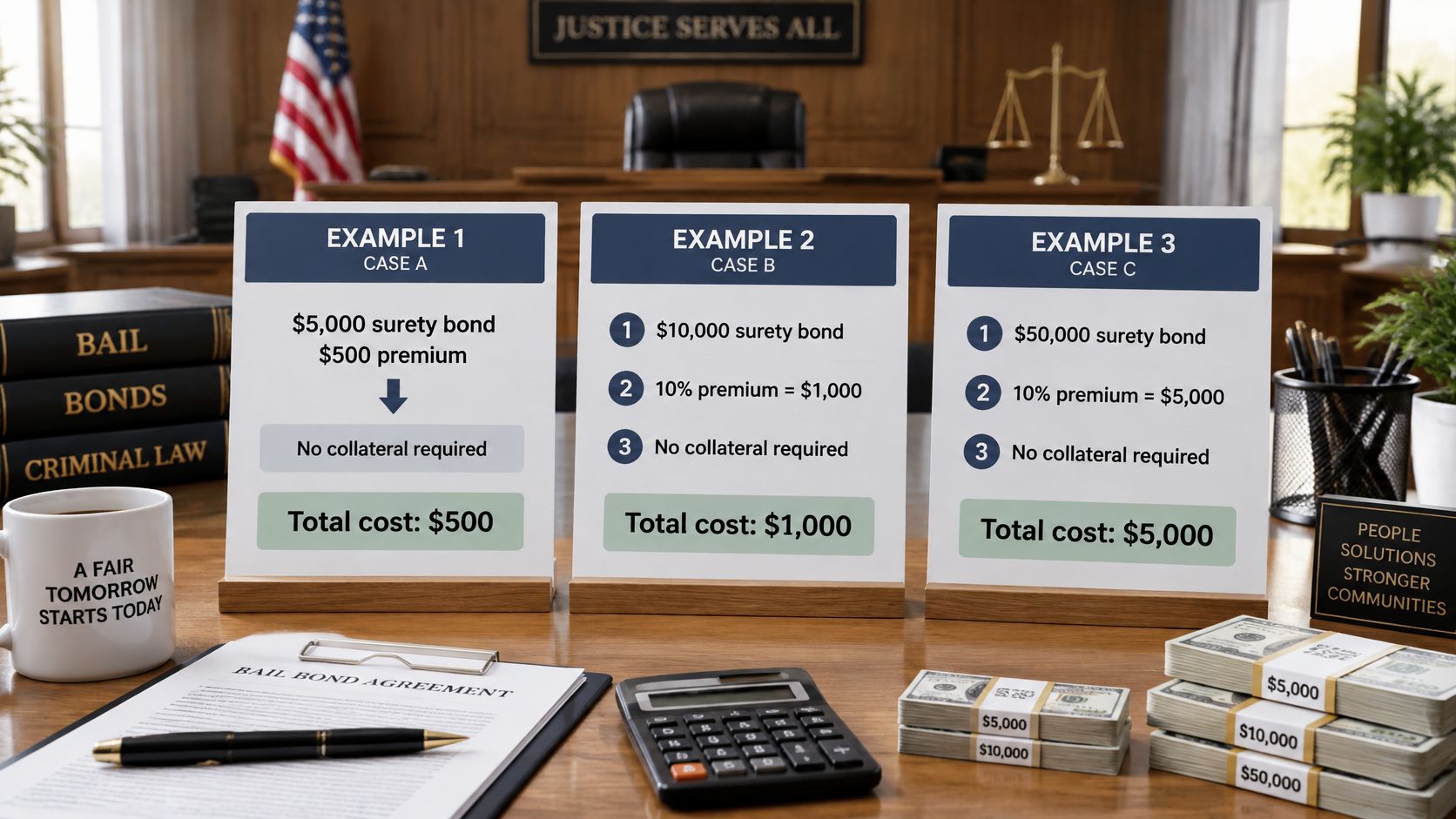
Case A, a smaller surety bond. Bail is set at $5,000, and the premium is $500, or 10% of bail. With no collateral required, the family pays $500 to the bondsman. The premium is nonrefundable, so it does not come back when the case ends.
Case B, a larger direct deposit. Bail is set at $25,000, and the family deposits $2,500 with the clerk. If all conditions are met, $1,875 is returned and $625 is retained, leaving a net cost of $625. The lower net cost comes with a higher upfront cash requirement: the family must provide $2,500 and wait until the obligations are discharged for the return.
Case C, premium plus collateral. Bail is set at $10,000, with a $1,000 premium. The bondsman also holds an asset valued by the family at $3,000. That means $4,000 is committed during the case: $1,000 is a nonrefundable fee, while the asset may be returned when the obligations are satisfied. A premium is money spent; collateral is property tied up until the return conditions are met.
Cost components to request in writing
| Cost item | Typical amount | Refundable? | Ask for in writing |
|---|---|---|---|
| Bond premium | 10% of bail in Florida | No | Exact dollar amount |
| Collateral | Set case by case | Usually returned when obligations end | Type, value and return conditions |
| Direct deposit retained | 25% of the 10% deposit | No | Amount the clerk keeps |
| Administrative or transfer fees | Not specified in these examples | Ask whether any amount is refundable | Itemized amount, if charged |
| Documentary stamp tax | Not specified in these examples | Ask whether any amount is refundable | Whether it is charged and included in the quote |
A written quote should distinguish the premium from money that may be returned, such as collateral or part of a direct deposit. If a charge has not been determined, ask the agent to identify it as pending and explain what will determine the amount. A quote far below the filed 10% premium rate deserves careful scrutiny, not an automatic assumption that it is a bargain.
Use this formula to compare the immediate cash demand:
Total cash needed = the premium, plus any nonrefundable charges, plus collateral you cannot access during the case.
The formula groups different kinds of costs, so check each one separately. The premium and other nonrefundable charges are spent; collateral may be returned, but it remains unavailable while the case is pending.
Why Inability to Pay Rarely Lowers Bail
Many families ask whether showing that they can't afford bail will lower it. Usually, inability to pay alone doesn't change the number at the jail window. Under Florida's 2025 pretrial release statute, cash, surety, and other monetary forms of pretrial release cannot carry different monetary amounts, and only a judge may set, reduce, or otherwise alter bail. A bondsman can't discount the court's amount, and jail staff can't negotiate it down for you.
The same framework permits a court to reconsider the monetary component when a defendant is unable to post a monetary bond, while requiring an annual statewide bond schedule for many offenses beginning in 2024. That means the path to relief normally runs through a judge, through a legally available nonmonetary release option, or through both. Release also gives the defendant time outside custody to hire an attorney and prepare a defense strategy, which is one reason families often pursue the bond and the court question at the same time.
If the amount is out of reach, work through these steps:
- Confirm the basics: Verify the bond amount, charges, and any release conditions with the jail.
- Ask counsel about court relief: Ask the defense attorney whether a bond reduction hearing or a nonmonetary release option is available, and review our overview of pretrial release in Florida before that conversation.
- Check for other holds: Ask whether another warrant, probation matter, immigration detainer, or court condition could keep the defendant in custody after this bond is posted.
- Explore payment timing: Ask the bondsman about a payment plan while any request to the court is pending.
A private "discount" offered at a bondsman's counter isn't a legal reduction in bail. Only the court can change the amount the court set.
Spot Unlicensed Agents and Confirm the Total Before You Sign
A quote far below the standard Florida premium should make you pause, not celebrate. Under Florida Statutes section 648.33, bail-bond rates must be filed with and approved by the state, and an agent may not charge above or below the approved rate. Florida law also prohibits executing a paid bail bond without charging the applicable premium, while limiting additional charges and deductions from collateral to those authorized by law. A bargain percentage can therefore be a compliance warning.
Families comparing agents by phone are especially exposed to incomplete quotes. One agent may quote only the premium, another may include taxes or transfer charges, and a third may not mention collateral until the paperwork is in front of you. The percentage alone can't tell you which offer costs less at signing.
Verify the provider in this order:
- Check the license: Confirm the agent's license through the Florida Department of Financial Services.
- Recalculate the premium: Compare the quoted premium with the 10% approved rate for a Florida state bond.
- Request an itemization: Ask for the premium, collateral, taxes, transfer fees, and payment-plan terms in writing.
- Confirm collateral return: Ask what must happen before collateral is released and how you'll be notified.
- Ask what is due at signing: Confirm whether the advertised percentage includes everything you must pay before release.
Watch for pressure to pay before you've reviewed paperwork, a percentage quoted without a dollar total, reluctance to explain collateral, or a demand for cash without a receipt. Each one makes it harder to prove what you paid and what you were promised. We offer free and confidential advice, and clients with questions about the bail process, bail fees, or collateral can call 305-597-4595.
Before any money changes hands, do one thing first. Obtain a written, itemized quote and verify the license.
If you're trying to work out the premium, collateral, and payment options for someone held in Miami-Dade or elsewhere in Florida, Blandon Bail Bonds, Inc. can explain the numbers, check the case details, and help you arrange the bond around the clock. Call for a free, confidential quote before you sign, so the total due at release is clear and documented.